Покупка на автомобил
26 August 2026 · 10 min read
Attractive photos, low advertised mileage and a spotless interior do not prove that a used car is a sound purchase. A proper pre-purchase inspection should establish three things: whether the vehicle matches its description, whether there are signs of hidden problems, and what additional costs may follow the sale.
This used car inspection checklist takes you through the process in a practical order, from speaking to the seller and checking the vehicle identification number (VIN) to assessing a cold start, taking a test drive and arranging independent diagnostics. It applies both to cars already in Bulgaria and to the preliminary assessment of vehicles offered for import. It cannot replace a qualified workshop inspection, but it can help you spot the questions and warning signs that matter.
Save this list and work through it for every car you consider. If a check cannot be completed, record why rather than assuming the result would have been satisfactory.
Documents and vehicle history
Bodywork and interior
Engine and transmission
Chassis and test drive
Before committing to the purchase
Some of the most useful questions are answered before you travel to see the car. Request its VIN, recent photographs of the actual vehicle, information about its origin and whatever service documentation is available. Ask directly about previous accidents, repainted panels, the date of the most recent service and any known faults.
Compare the dates, recorded mileage and work described in the available records. If a more recent record shows a lower mileage than an earlier one, ask for an explanation supported by further evidence. A VIN history report is a useful screening tool, not proof of a spotless past. Databases do not necessarily capture every accident, repair or registration event.
Ask whether the seller will permit an independent inspection and a test drive, and whether the engine can remain cold until you arrive. A refusal does not automatically prove that something is wrong, but it does justify more questions before making a financial commitment.
Inspect the car in daylight, ideally when its bodywork is reasonably clean and dry. Compare the shade and texture of paint on adjacent panels, the consistency of panel gaps and the alignment of headlamps and rear lights. Look for disturbed bolts on doors, wings and bonnets, as well as overspray on seals or trim.
A repainted panel does not necessarily indicate a serious collision. It could be the result of a scratch or minor parking damage. What matters is the extent of the repair, its quality and whether any structural components or safety systems were affected. Where there is reason for concern, paint-thickness measurements and an inspection on a lift can help. Readings from a paint gauge must, however, be interpreted in the context of the panel material and the particular model.
Do not overlook the boot floor, spare-wheel well, sills, lifting points and accessible parts of the underbody. Damp carpets, unusual corrosion around electrical connections or inconsistent fasteners deserve closer investigation. Glass markings or dates that differ from other windows are also worth asking about, but they are not conclusive evidence of accident damage.
Cabin condition should make sense for the vehicle's age, use and claimed mileage. Heavy wear on a steering wheel in a supposedly low-mileage car warrants investigation, but it does not establish odometer tampering on its own. Material quality, cleaning habits and frequent urban use all influence wear.
Test the equipment you are paying for: electrically adjustable memory seats, heating and ventilation, dual- or multi-zone climate control, a powered tailgate, parking sensors, cameras, infotainment, keyless entry, lighting and driver-assistance functions. On a premium car, a single malfunctioning convenience feature can involve sophisticated electronics or an expensive component.
When switching on the ignition, observe the dashboard warning lights, including the airbag and ABS indicators. If an expected warning does not appear during the initial self-check, or a warning remains illuminated after starting, seek specialist diagnostics. Never dismantle or interfere with safety systems to check them without a qualified technician.
Starting an engine from cold may reveal symptoms that become less noticeable once it warms up: difficult starting, unstable idle, unusual mechanical noises or smoke. Confirm beforehand that the engine is genuinely cold. Observe how quickly it starts, whether the idle settles and whether the dashboard displays warnings.
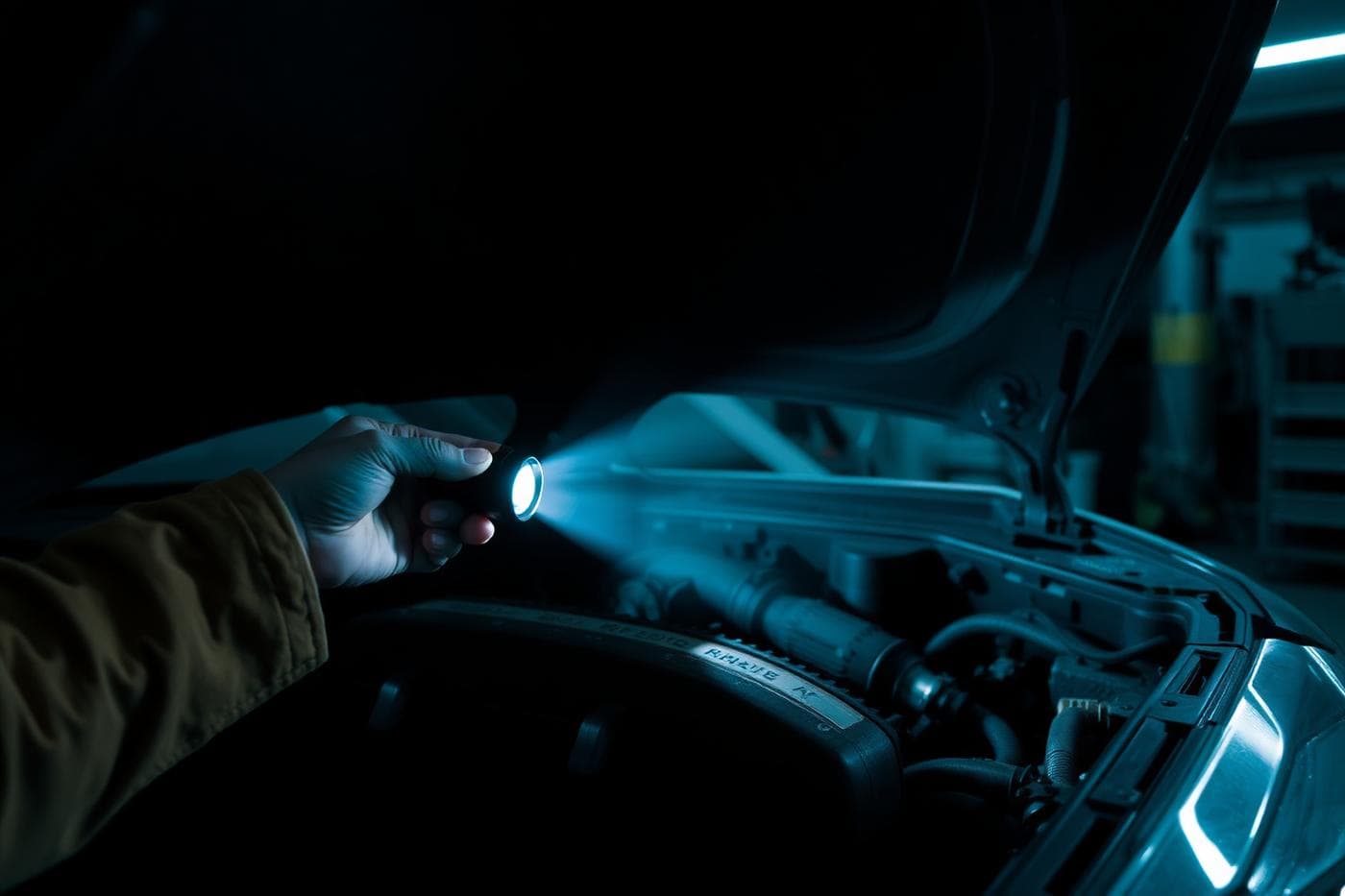
Under the bonnet, inspect visible hoses, seals, joints and housings for signs of leakage. Check accessible oil and coolant levels in accordance with the manufacturer's instructions. Never open the cooling-system cap when the engine is hot: the system may be pressurised and could cause serious burns.
Do not diagnose a fault solely from exhaust colour. Brief water vapour in cold weather is not necessarily a problem; persistent abnormal smoke after warm-up needs further investigation. For diesel vehicles, pay attention to the emissions-control systems. For turbocharged petrol engines, check for smooth acceleration, suitable cooling-system operation and evidence of consistent maintenance.
With a manual gearbox, check that all gears engage normally, assess clutch operation and listen for unusual noises. With an automatic transmission, observe engagement of Drive and Reverse, pull-away behaviour and gear changes under different loads. Noticeable jerks or delays can have different causes, so any fault should be diagnosed with reference to the specific transmission rather than assumed to have one universal explanation.
Inspect all four tyres. Are their sizes correct for the vehicle? How much tread remains? Are there cracks, bulges or uneven wear? The final four digits of a complete DOT tyre identification code generally indicate the week and year of manufacture. Irregular wear may point to wheel alignment, suspension or tyre-pressure issues, but the underlying cause needs to be established.
Look at the visible condition of brake discs, pads and dampers. An inspection on a lift is particularly useful for finding hidden leaks, play in suspension components, corrosion and problems with mounting points.
A short circuit around a car park rarely tells the full story. Where permitted and safe, drive on ordinary urban roads and on a suitable stretch with a higher legal speed limit. Avoid aggressive or unsafe manoeuvres and pay attention to the following:
After the drive, check again for leaks, overheating smells and active dashboard warnings. If the seller will not allow a test drive, request a practical alternative assessment at a workshop or acknowledge that an important part of the car's condition remains unverified.
A clean engine bay and a dashboard with no illuminated warnings do not rule out hidden defects. Independent checks should be selected for the vehicle's model, engine, equipment and known history.
| Inspection method | What it can reveal | Important limitation |
|---|---|---|
| Electronic module diagnostics | Stored fault codes, live data and system status | Cannot detect every mechanical issue; previously cleared codes may no longer be visible |
| Paint-thickness measurement | Variations in paint thickness and indications of past refinishing | Does not establish the severity of an accident by itself |
| Inspection on a lift | Corrosion, leaks, repairs and suspension condition | Some faults only appear while driving or after disassembly |
| Service-record review | Maintenance history and previously recorded mileage | An incomplete record is not automatic proof of fraud |
| Hybrid or EV system assessment | Available diagnostic data about the high-voltage system and battery | Scope and reliability depend on the model and test method |
No single test can guarantee genuine mileage or the absence of concealed accident damage. The most reliable assessment compares the physical condition, documents, recorded history, diagnostic findings and on-road behaviour together.
If a car is offered for import, your assessment needs to go beyond its photographs and advertised price. Clarify the country of origin, registration status, available maintenance documents, accident information and exact vehicle specification.
For vehicles sourced from the United Arab Emirates and other Gulf markets, consider checking the regional equipment specification, air-conditioning and cooling systems, the condition of seals and the availability of suitable replacement parts. This does not mean every vehicle from a hot climate has problems. The condition and history of the individual example are what matter.
For a vehicle from Japan, check steering-wheel position, lighting, infotainment and configuration differences that may matter in Bulgaria. For a vehicle from South Korea, compare the specific variant, equipment and identification details against the available service information. Whatever the market, clarify the car's eligibility for registration and the transaction-specific costs before placing an order.
If you would like to search beyond locally advertised cars, explore vehicles sourced to order and how Kaizen Motors works. You can define your requirements for provenance, condition and equipment before committing to a particular vehicle.
Not every defect is a deal-breaker. Worn tyres, upcoming scheduled maintenance or minor cosmetic damage may be reasonable if they are fully disclosed and reflected in the price. Other warning signs call for the transaction to stop until the uncertainty is resolved:
In these situations, the sensible decision is often not to pay a deposit until the risk has been clarified. If material uncertainties remain, consider another vehicle.
Two vehicles advertised at the same price can have very different total acquisition costs. Add the repairs you can substantiate, immediate servicing, tyres, brakes and other identified expenses to the purchase budget. For an imported car, include the transport, administrative and registration costs applicable to the individual transaction. Generic estimates are no substitute for a specific quotation.
It helps to sort inspection findings into three groups: immediate safety-related repairs, essential maintenance in the near term, and cosmetic or deferrable improvements. This makes it easier to judge whether a negotiated discount adequately reflects the car's actual condition.
With Kaizen Motors, you can start by exploring available vehicles or submitting a vehicle sourcing request. Describe the model, budget and priorities, including the history and technical details you want clarified before a purchase is considered.
Begin with the VIN, provenance and documents, then compare service records with the vehicle's physical condition. A cold start, road test and independent diagnostics provide additional evidence of technical risk.
No. A VIN report can only show information available from the sources it uses. The absence of a damage record or mileage discrepancy does not prove the vehicle has never been repaired or that its odometer reading is unquestionably correct.
Not necessarily. The cause and extent of the repair matter, especially whether structural components or safety systems were affected. Minor cosmetic refinishing is very different from major structural reconstruction.
Some noises, starting difficulties and operating irregularities are more noticeable before the engine warms up. A cold start is informative, but it does not replace assessment at operating temperature or diagnostic testing.
An independent inspection is not a universal legal formality for every sale, but it is strongly recommended, particularly for a high-value vehicle, incomplete history or suspected repairs. The scope should match the model and risks identified.